Research & Development
We build the tools before we sell the service
Cloudly Studio started as a research project, not a studio. Every capability we offer today began as an open technical question: could we do this accurately, repeatably and fast enough to be worth offering? This page records those questions, what we built to answer them, and where each one stands.
Why a 3D studio does R&D
Research that stays close to real production problems
Methods before the market has them
Clients get approaches we have already tested on our own projects, not experiments run on their deadline.
No black boxes
The core tools, from our product viewer to our pipelines and quality checks, are ours. We can explain, adapt and support them.
Accuracy first
Generative AI is useful, but it is never allowed to change what an engineer approved. Much of our research is about where that line sits.
The research thread
One question, asked six ways
Each project removed one bottleneck between a real object and an accurate, reusable digital version of it: first people, then products, scenes and drawings, and now whole environments.
-
Digital twins of real people
The questionCan a real person's likeness be reproduced photorealistically and consistently enough to stand in for a photo shoot?
What we builtImage models fine-tuned on reference photographs of real people, and a testing routine for identity consistency across poses, lighting and framing.
What it unlockedThe identity-consistency methods behind our clothing and accessory visualisation app. This work began before Cloudly Studio was incorporated and was brought into the company when it was founded.
-
Our own 3D product viewer
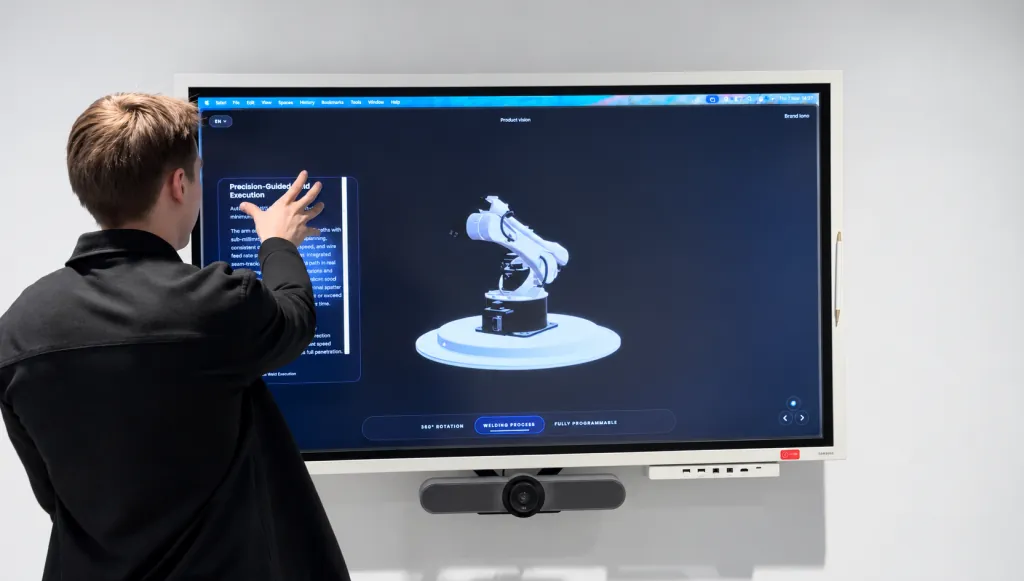
The questionCan a browser show an engineering-accurate product, with exact geometry, real materials and photoreal light, on a trade-show touchscreen or a phone, quickly, and without generative AI going anywhere near the geometry?
What we builtA viewer built on three.js, with an experimental in-house WebGL2 rendering engine alongside it. It has compressed geometry and textures for fast loading, image-based studio lighting, and hotspots anchored to individual parts, placed with our own editor. Animation is split into chapters, and the view hands off seamlessly from live 3D to 4K pre-rendered video. The viewer went through several generations and more than 140 recorded revisions.
What it unlockedOur interactive product experiences, including the robotics pavilion demo.
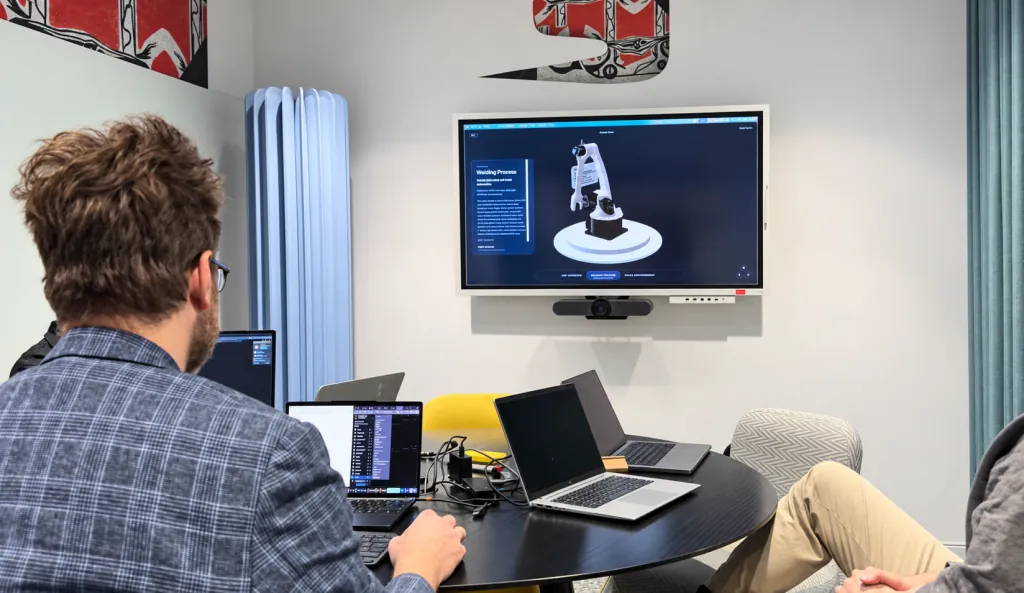
Review session on the product viewer: every iteration is tested on the screen sizes it will actually be used on. -
Curatable 3D scenes with generative AI
The questionCan a non-technical marketer compose a showcase scene and get a render-quality image, with generative AI building the surroundings, while the product itself stays exactly as engineered?
What we builtA scene-builder MVP that keeps the product layer (geometry, proportions and materials) separate from the environment layer that AI is allowed to generate.
Where it standsThe MVP works. The open problem is keeping lighting and reflections physically consistent between the protected product and the generated environment.
-
Real 3D models from 2D drawings
The questionMany industrial products exist only as 2D technical drawings. Can those drawings be turned into dimensionally reliable 3D models without rebuilding each one by hand?
What we builtA prototype that finds the separate views on a drawing sheet, identifies front, top and side, aligns them by their dimensions and reconstructs a solid model for the web. In parallel, we tested reconstruction from photographs.
Where it standsResults are promising on simple geometry. Complex intersecting shapes are the open problem we are working on now.
-
Detailed clothing and accessory visualisation
The questionCan generative AI show a specific garment or accessory as it really is, with its exact colour, fabric and details, instead of a plausible lookalike?
What we builtA working application that combines several image-generation engines with an automatic quality gate. Every output is scored against the original product references, and anything below the threshold is regenerated with targeted corrections. The app also plans the minimum set of shots each product needs and records which inputs produced every image.
What it unlockedA principle we now apply everywhere: AI output is only accepted after it has been checked against the source of truth.
-
Gaussian splat environment capture
The questionCan a real facility, whether a production hall, a line, a showroom or a trade-show stand, be captured as navigable, photoreal 3D quickly enough to be commercially practical, and combined with the precise CAD-based product models we already make?
Where it standsWe are testing capture equipment, processing methods and web delivery. This is where we are looking for industrial pilot partners (see below).
How we run research
Research with a paper trail
Every project starts with a written question and the uncertainties we need to resolve. Work runs in short iterations, and each experiment is recorded, including the ones that fail, because those show where the real limits are.
Research is kept apart from client production. A method only moves into our standard pipeline once it has been validated, so clients get the result, not the experiment.
The result: new capabilities reach clients already tested, documented and owned by us.
Gaussian splat pilot
Show your facility, not just your product
We are selecting two or three industrial companies to take part in an early Gaussian splat pilot. A production line, a hall, a showroom or a trade-show stand, captured as a navigable, photoreal 3D space that runs in a browser.
Apply for the pilotSuited to
- manufacturers who sell on capability, not only on product
- sites that are hard or costly for customers to visit
- teams preparing for a trade show
Pilot partners get
- early access to the method
- direct involvement in how it develops
- pilot terms
Further Reading
Practical guides from the team on specs, systems, and workflow.
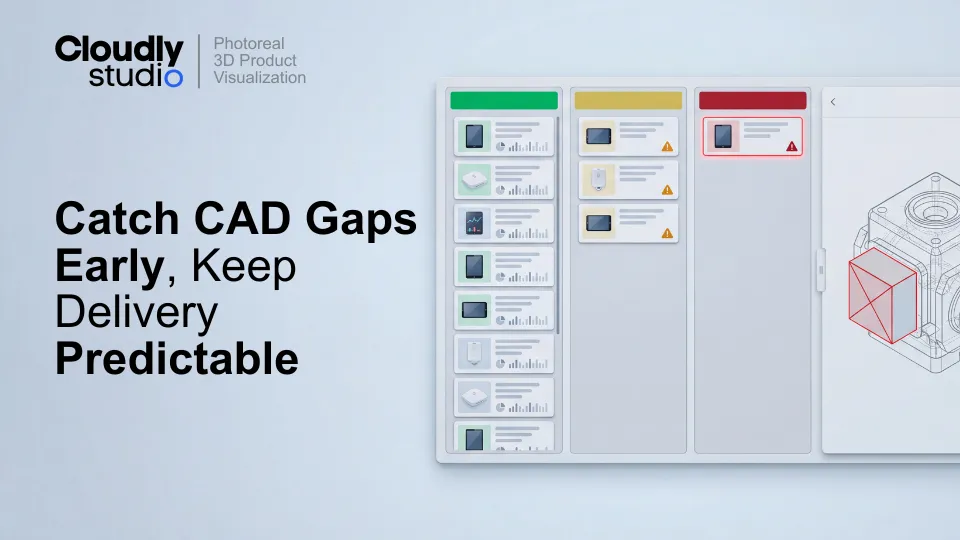
Evaluating CAD Drawings & STEP Files on Day One - Predictable 3D Rendering
How we triage CAD drawings, technical drawings, and STEP files before starting 3D rendering - catching geometry gaps on day one so every render delivery stays on schedule.
Read article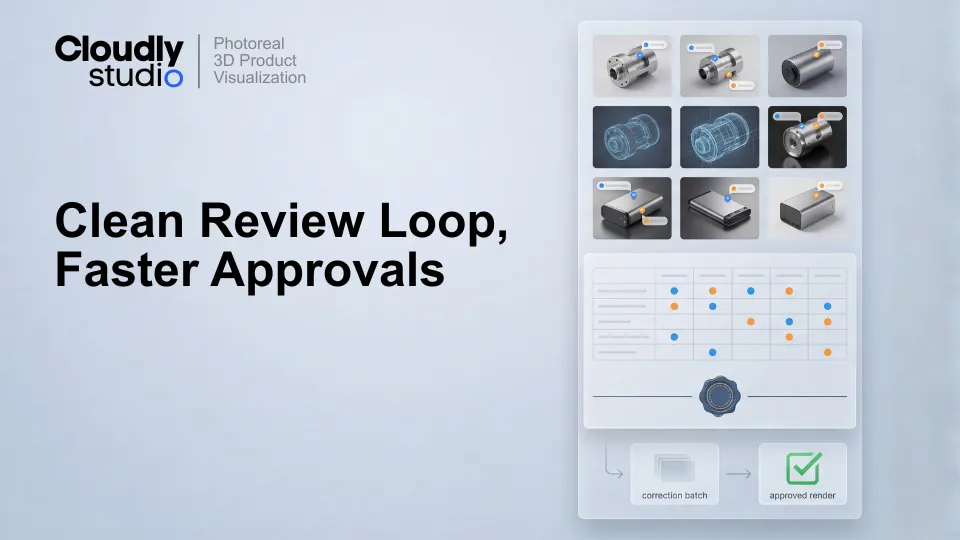
Stop the Review Ping-Pong - 3D Rendering Approval Workflow That Ships
Cut 3D rendering review cycles down to one structured batch. How we manage feedback on CAD drawings and technical drawings without endless back-and-forth corrections.
Read article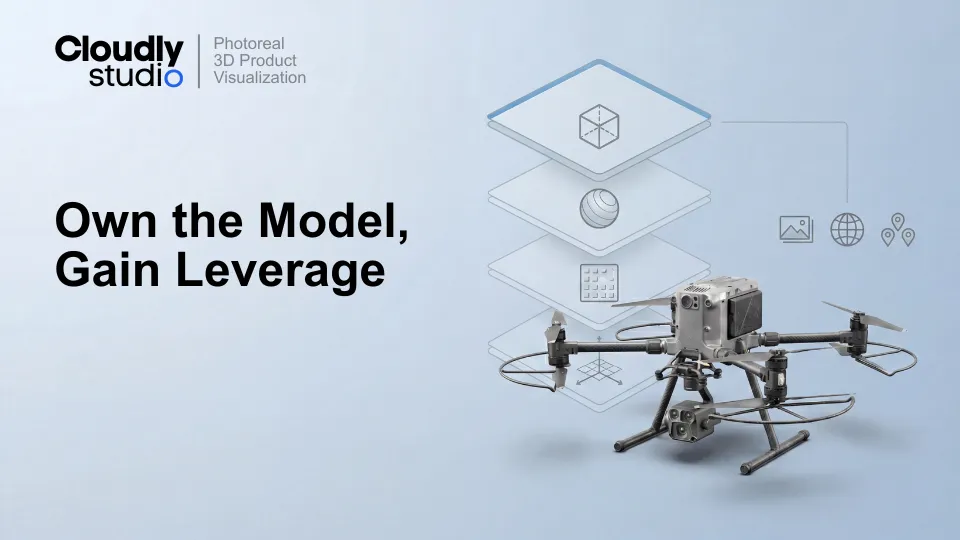
Render-Only vs Owning the 3D Model - ROI on CAD Drawings & 3D Assets
When does owning the 3D model built from your CAD drawings become a business lever? The render-only vs model ownership comparison for teams managing large SKU catalogs.
Read article